Which type of imposter are you?
You get the promotion, deliver the presentation or receive brilliant feedback, yet somehow, your brain still finds a reason why it doesn’t count.
You had help, you took too long, you stumbled over a sentence, you couldn’t answer one particular question.
Sound familiar?
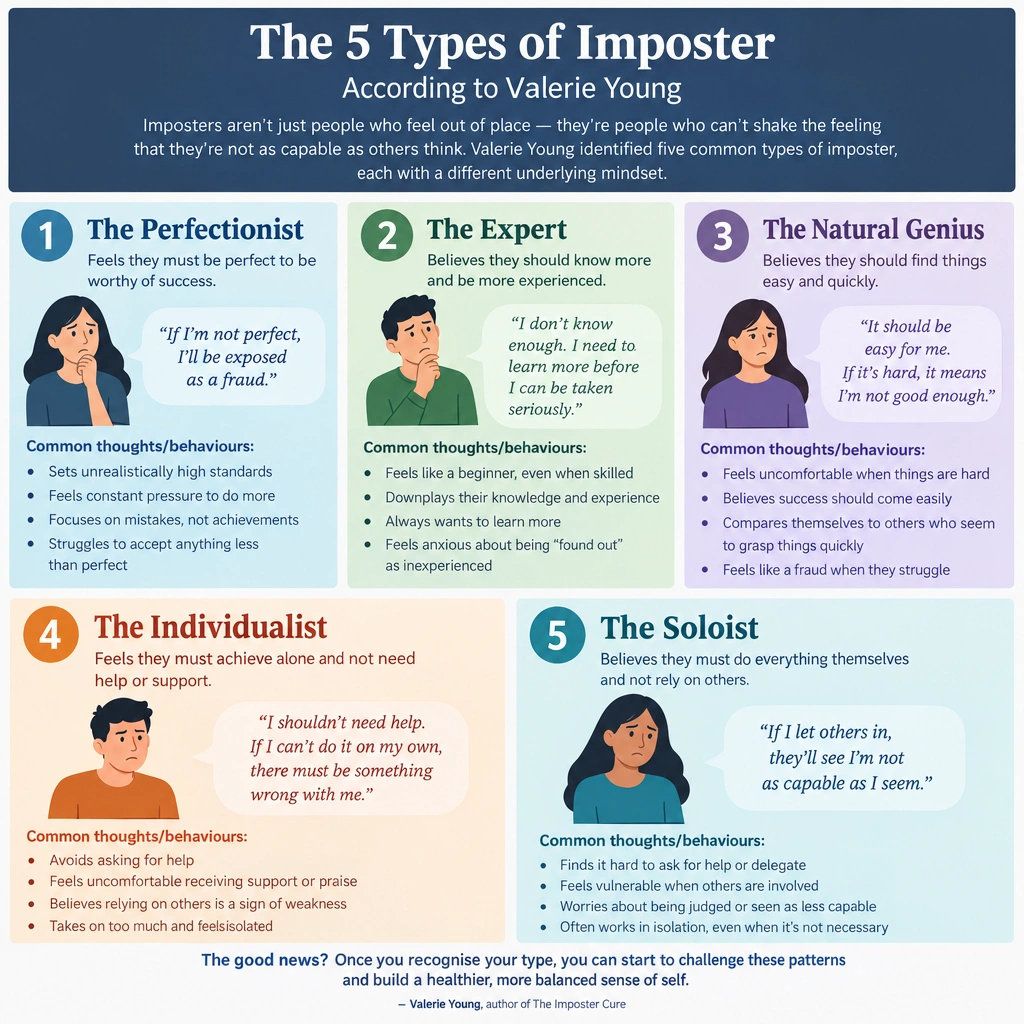
Dr Valerie Young’s five competence types explore the different expectations we place on ourselves when we experience imposter feelings: the Perfectionist, Natural Genius, Soloist, Expert and Superhuman. Each reflects an unrealistic rule about what being capable should look like.
The important thing is to think of these as patterns to notice, rather than labels to stick on yourself. You might recognise yourself in one or several of them, but that’s okay. Recognising these patterns is the first step to take in overcoming them.
One useful question is: what are you demanding of yourself before you’ll accept that you’re good enough?
1. The Perfectionist
“If I were really good at this, I wouldn’t make mistakes.”
The presentation went well – people were engaged, the discussion was useful and your manager thanked you afterwards. However, all you’re thinking about is the slide you forgot to update. For the Perfectionist, a small flaw can overshadow everything that went right. There’s always something to improve before something deserves to be recognised. At work, this might mean endlessly editing an email, struggling to delegate or delaying a project because it isn’t quite ready.
Challenge the rule: Decide what a successful outcome looks like before you start. What does this piece of work actually need to achieve? Give yourself a clear finishing point.
High standards can help you do good work, but you need to make sure they’re not holding you back.
Ask yourself: Am I improving the outcome, or trying to remove every possibility of criticism?
2. The Natural Genius
“If I were genuinely capable, this would come easily.”
You’ve stepped into a new role and suddenly things take more effort. You need to practise, ask questions and occasionally get things wrong. However, instead of allowing yourself to learn, you start wondering whether you were the wrong choice.
The Natural Genius treats difficulty as evidence of inadequacy – if you can’t do something quickly or get it right first time, perhaps you’re simply not good at it.
Challenge the rule: Give yourself permission to be a beginner. Identify what you need to practise and look for progress across several attempts.
Your first presentation, difficult conversation or experience of managing someone doesn’t need to demonstrate complete mastery. No one is perfect on their first attempt, so why should you expect yourself to be?
Ask yourself: What would change if I expected this to take practice?
3. The Soloist
“It only counts if I do it myself.”
You’re stuck, but you won’t ask a colleague. You’re overloaded, but you won’t delegate. Someone offers support and you automatically say you’re fine.
The Soloist, sometimes called the Rugged Individualist, feels that help somehow reduces the value of an achievement. This mindset can leave you carrying far more than you need to.
Challenge the rule: Treat seeking support as part of doing the job well – knowing whose expertise to draw on is a useful leadership skill.
Try making one specific request: feedback on a proposal, help prioritising or a conversation with someone who has done this before.
Ask yourself: Would I think less of a colleague for asking me for the same help?
4. The Expert
“I need to know more before I’m ready.”
Another qualification, another book, another evening researching.
Learning is valuable, but you keep moving the point at which you’ll feel sufficiently informed to apply, speak up or get started. For the Expert, a gap in knowledge can feel like proof that they shouldn’t be in the room.
Challenge the rule: Separate what you need to know to start from what can be learnt along the way. Choose a specific next step and identify the knowledge that step actually requires. Remember, you can contribute something useful without being able to answer every possible question.
Ask yourself: What do I already know enough to do?
5. The Superhuman
“I should be able to handle all of this.”
You want to be a brilliant professional, supportive partner, present parent, reliable friend and still find time to exercise and look after yourself. When one area needs more attention (which is inevitable with so many roles), you suddenly feel like you’re failing somewhere else.
Young calls this type the Superhuman – you might recognise it as the pressure to be a superhero: proving yourself through how many roles you can fulfil exceptionally well.
Challenge the rule: Decide what deserves your energy right now, and what can receive less, but make sure you set a boundary before your capacity is completely used up.
Remember – you don’t have to earn rest by reaching the end of a never-ending list.
Ask yourself: What am I trying to prove by saying yes to everything?
Recognise the pattern. Challenge the rule.
Perhaps one description felt particularly familiar; maybe you recognised yourself in all five.
Starting with one situation this week, notice the expectation you’re placing on yourself, question whether it’s reasonable and try a different response – send the finished proposal, ask for help, let yourself practise and get feedback. Then try asking yourself: are you expecting more from yourself than you’d expect from your colleagues?
Make sure you leave room to question your environment too. Unclear expectations, exclusion or an unmanageable workload also deserve attention. These factors can also play a big part in those imposter feelings.
Feeling like an imposter doesn’t mean you are one.
If these patterns are affecting the opportunities you pursue or how you feel at work, coaching offers space to explore them and practise doing things differently.
At GMW Coaching & Leadership, I’ll support and challenge you to recognise what’s holding you back, question the rules you’ve been living by and take your next step.
What might you do differently if you stopped making yourself prove your worth every day?
Read more about imposter syndrome and the other glass-ceiling factors, or get in touch to explore coaching.
The five competence types come from Dr Valerie Young’s book The Secret Thoughts of Successful Women (2011).