Does your personality type affect your confidence at work?
Confidence does not always look the way we expect. Explore personality preferences, the assumptions we make and what trusting yourself could look like.

The person speaking most confidently in the meeting might spend the evening questioning everything they said. Meanwhile, the quieter person beside them might feel entirely comfortable with their expertise, they simply haven’t felt the need to contribute yet.
From the outside, it’s easy to decide which person is more confident. Whether we’re right is another matter. When we talk about confidence at work, we often picture someone who speaks up, makes decisions quickly and looks comfortable being noticed. If that doesn’t sound like us, we can start to believe confidence belongs to a different kind of person - someone louder, more outgoing, more naturally assertive.
But how much are we really seeing - and how much are we assuming?
What personality preferences actually tell us
If you’ve come across Insights Discovery, you’ll probably recognise its four colour energies: Fiery Red, Sunshine Yellow, Earth Green and Cool Blue.
The framework offers a way to explore how we prefer to communicate, interact and make decisions. We each have a blend of all four energies, rather than belonging to one fixed box. These preferences can help us understand someone’s approach, but they don’t give us access to their internal conversation. Being decisive doesn’t tell us whether someone trusts their judgement, being sociable doesn’t tell us whether they feel they belong, and taking time to think doesn’t tell us someone is doubting themselves.
Let’s explore how that could look at work. The examples below are possibilities to reflect on, rather than predictions about particular colour energies.
Fiery Red: “You look like you’ve got everything under control”
Fiery Red energy is associated with a direct approach and a focus on action and results.
Someone who moves a discussion forward and makes a clear decision can look very confident.
And they might be, but they might also be telling themselves a very different message: Imagine that same person privately thinking:
“I’m supposed to know what I’m doing. What happens if I get this wrong?”
Maybe they take ownership because they trust themselves, but what if they feel they cannot afford to be seen hesitating. The observable behaviour can look similar but the experience for the individual underneath it can be very different.
A question to consider: When you take charge, do you feel able to ask for help too?
Sunshine Yellow: “But you’re so outgoing — how can you lack confidence?”
Sunshine Yellow energy is associated with enthusiasm, sociability and expressive communication. It’s very easy to assume someone who enjoys meeting people must feel comfortable in themselves, yet being able to start a conversation doesn’t automatically mean feeling secure about your contribution.
Imagine someone who brings energy to a presentation, connects with the room and receives positive feedback, yet afterwards, they think:
“They liked me, but did I actually say anything useful?”
Their ease with people may be real, however that doesn’t remove their uncertainty about whether their expertise is valued.
A question to consider: Can you recognise the value you brought, even when nobody explicitly praises it?
Earth Green: “You just need to speak up more”
Earth Green energy is associated with patience, consideration and an emphasis on relationships and values.
Someone who listens carefully and makes space for others may be labelled as lacking confidence, but listening can be a deliberate choice. You can feel secure in your judgement without needing to dominate the discussion. Equally, someone might hold back because they are worried about disappointing others or creating tension.
Imagine two people choosing not to challenge a suggestion - one thinks it’s a sensible proposal but doesn’t feel the need to add to a sea of yeses, whereas the other disagrees but doesn’t feel able to say so.
Their silence tells us very little about how they’re feeling.
A question to consider: Are you choosing to make space for others, or feeling unable to take up space yourself?
Cool Blue: “You’re overthinking it”
Cool Blue energy is associated with careful analysis, accuracy and a considered approach. Someone who asks questions or wants time to review information can be mistaken for someone who lacks confidence, but checking the evidence may simply be how they do good work. The useful question is what happens when they have enough information - can they move forward or does the threshold keep shifting?
Imagine someone reviewing a presentation again because they think:
“If there’s one question I can’t answer, they’ll realise I shouldn’t be doing this.”
That is a different experience from choosing to prepare thoroughly because accuracy matters.
A question to consider: What would “prepared enough” look like, and would you allow yourself to stop there?
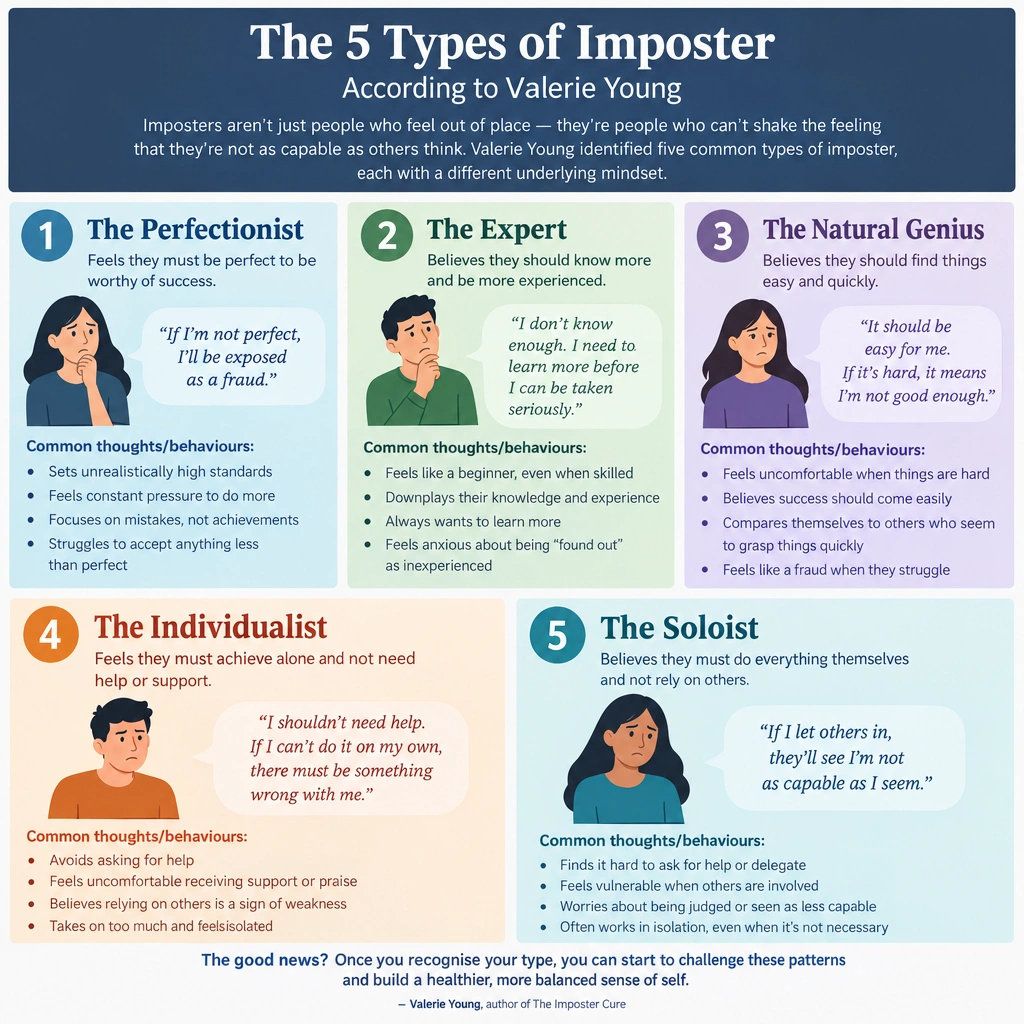
Where does imposter syndrome fit?
Imposter feelings involve doubting your capability or struggling to accept your achievements, alongside a fear that others will discover you’re less capable than they think. They are more specific than simply feeling nervous about a difficult task and, importantly, that fear doesn’t come with one recognisable outward appearance.
Someone might deliver a polished presentation while believing they have fooled the audience. Someone else might avoid putting themselves forward because they worry they couldn’t maintain that impression.
This doesn’t mean every confident-looking person is secretly struggling but it also doesn’t mean every quiet or careful person needs a confidence intervention.
It means we need to be curious about what is happening underneath the behaviour.
If you’re supporting someone at work, “How did that feel for you?” may reveal more than “You seemed confident.”
If you’re reflecting on yourself, try asking: What am I telling myself this situation proves about me?
You don’t need a different personality to build confidence
There isn’t a confidence ranking hidden in the four colour energies - an energy preference cannot tell us how confident a particular person feels, and an outward style is not reliable proof of inner self-belief. Confidence can look like making a decision but it can also look like asking a question, admitting you don’t know, holding a boundary or giving yourself time to think. You might trust yourself when supporting your team yet doubt yourself when presenting to a senior leader, or maybe you feel comfortable discussing your expertise but uncomfortable explaining why you deserve a promotion.
Rather than asking, “How do I become more like that confident person?”, a more useful question could be:
“What would trusting myself look like in this situation, in a way that feels like me?”
Perhaps that means contributing before you’ve perfected your wording. Perhaps it means asking for support instead of assuming you should cope alone. Perhaps it means accepting positive feedback without immediately explaining it away.
Importantly, none of those requires you to become someone else.
Let’s work out what’s actually holding you back
In 1:1 coaching with GMW, we can explore the situations where you doubt yourself, the expectations you’re trying to meet and the patterns that may be keeping you stuck.
You’ll have space to think honestly, alongside questions that challenge the assumptions you may have stopped noticing. Together, we can identify practical steps towards something that matters to you - whether that’s speaking up, pursuing an opportunity or trusting your own judgement.
You don’t have to become the loudest person in the room. What would change if you trusted the value you already bring?